
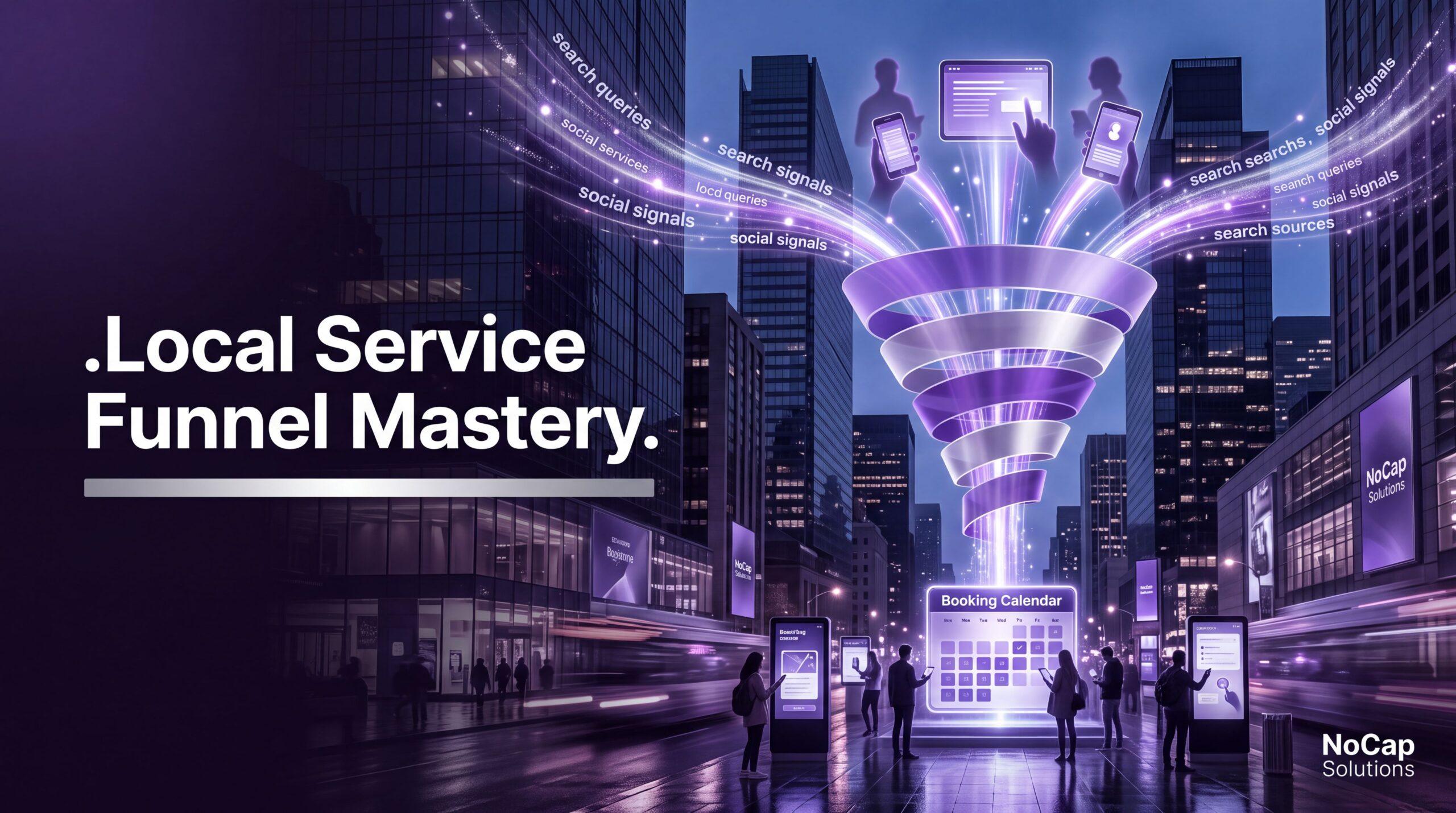
Local Service Funnel: SEO to Booking to 20% Conversions
Local Service Funnel: Driving SEO Leads to 20% Conversions
Discover a comprehensive guide to optimizing your local service funnel from SEO and ads to booking and retaining customers, achieving up to 20% conversion rates.
This article outlines an effective approach to building a high-performance local service funnel that integrates organic search, SEO, and digital strategies to drive quality leads and boost conversions. The content explains how to attract new customers, improve online scheduling, and engage returning clients, offering actionable insights for local service businesses looking to grow.
1. Attracting New Customers Through Multiple Channels
Imagine a bustling local service business where every interaction becomes a new opportunity – a modern marketplace where potential customers aren’t just coming through one door, but several. In today’s digital age, the journey to acquire new customers is both diverse and dynamic. Local service businesses must embrace a multi-channel approach that not only pulls in prospective clients but also builds relationships, nurtures trust, and positions the business as a local authority. This section unpacks the myriad ways to attract new customers, drawing from the comprehensive insights of modern B2C customer journey strategies.
Local service businesses operate in environments where community trust and visibility are paramount. Organic search remains one of the top channels driving interest and traffic. When a potential customer types a query into Google, it is essential that the business’s website appears at the top of those search results. This isn’t just about having content on a website – it’s about curating valuable, optimized content that addresses real customer needs. Effective organic search strategies involve detailed keyword research, content that answers common customer questions, and the continual updating of online content to reflect evolving trends. Each piece of content is designed to resonate with search engines and users alike, ensuring that local service providers remain relevant and visible. The strategy transcends mere visibility; it is about positioning the business as the go-to expert in its field.
Beyond organic search, cultivating a strong social media presence is indispensable. Today, social platforms are not just for casual conversations; they have evolved into robust marketing channels where a local service business can engage potential clients in real time. An engaging social media profile consistently shares updates, behind-the-scenes glimpses, service highlights, testimonials, and community stories that resonate with local audiences. Various platforms such as Facebook, Instagram, Twitter, and even LinkedIn provide channels to target different demographics. For example, a plumbing service might share practical tips on water conservation, while a landscaping company showcases stunning before-and-after shots of local projects. This mixture of useful information and visual appeal creates a compelling narrative that attracts attention and builds credibility. Engagement is further enhanced when social media profiles incorporate multimedia elements like images, short videos, and even live sessions that answer real-time questions from community members.
Paid advertising often gets a bad reputation as being excessively aggressive, but when executed correctly, it can be one of the most efficient methods for boosting visibility. Through paid search ads, local service providers can target specific geographies, demographics, and even interests. This type of advertising, when combined with a well-designed campaign, can elevate brand awareness almost overnight. Strategies in paid advertising include meticulously crafted messaging that speaks directly to the needs of the audience, A/B testing of ad copy and visuals, and dedicated budgets that assure a monitored and scalable approach. The key is to balance paid strategies with organic methods so that every dollar spent brings measurable, reliable returns. Because in local markets, reputation and timely service are critical, the right ads not only draw clicks but also breed trust and encourage further engagement.
Moreover, diversifying the customer acquisition strategy by incorporating additional methods like referrals, direct mail, and even proactive prospect calls can yield tremendous benefits. Traditional methods continue to work because they complement digital channels. For instance, a referral from a delighted customer on social media or through word-of-mouth can often trigger a more immediate, trusting response than a cold digital interaction. Direct mail, though seemingly old-fashioned in the digital era, can stand out exactly because it is not as ubiquitous. Custom-tailored messages, high-quality printing, and a personalized touch can create a tangible connection in an increasingly digital landscape. Similarly, strategic prospect calls ensure that leads who might have shown interest online are followed up with human connection – a factor that cannot be understated when building local trust. By marrying both digital and traditional channels, local service businesses cover every base, ensuring that no potential customer slips through the cracks.
A robust digital strategy does not rely on one single method – it is an ecosystem where each channel feeds into and supports the others. For example, a customer who first discovers a business through a paid ad might later search online organically for reviews and additional information, and subsequently follow social media profiles for updates. This comprehensive approach creates a layered customer journey where every touchpoint reinforces the brand’s message and value proposition. Data from each channel can be analyzed to identify which methods are most effective, allowing business owners to refine and recalibrate their marketing mix. For instance, metrics from organic search might indicate a strong correlation between keyword-specific articles and phone inquiries, leading the business to expand that content further. Similarly, positive social media campaigns often encourage paid advertising to amplify the message.
Local service businesses that adopt a multi-channel approach find themselves with a diversified portfolio of customer acquisition methods. This diversification not only hedges against the unpredictable nature of any one channel but also ensures that each prospective customer interacts with the business from various angles before making an informed decision. When every method, whether digital or traditional, works in concert, the journey from discovery to conversion becomes both smooth and engaging. In essence, the modern local service provider is no longer dependent on a single source of traffic – it can harness the power of organic search, a vivid social media presence, carefully placed paid advertisements, and traditional outreach methods to capture a broad spectrum of customer segments.
2. Optimizing the Funnel from Lead Capture to Conversion
Once prospective customers have been attracted through varied channels, the next challenge becomes converting that interest into actionable leads and ultimately, paying customers. This transformation from a casual browser to an engaged lead is akin to guiding a traveler through a well-lit pathway from discovery to destination. In this part of the strategy, the focus turns to the design and optimization of the sales funnel – a measured process that seamlessly captures attention, nurtures leads, and drives conversions.
The initial stage in this funnel is lead capture, which is critical for converting a visitor’s fleeting interest into something far more tangible. Every click, every phone call, and every inquiry represent a potential step forward in a customer’s journey. To effectively capture a lead, businesses must ensure that their online properties – websites, landing pages, and even social media profiles – are optimized for conversion. This includes having clear call-to-actions (CTAs), forms that are simple and user-friendly, and mechanisms that track visitor behavior across digital touchpoints. When a potential client lands on a website and finds a well-structured page with obvious next steps, the likelihood of them leaving their contact details increases considerably.
An essential aspect of lead capture is the ability to track and manage leads efficiently. This means implementing systems that record crucial information, such as the source of the lead, behavioral patterns on the website, and the time spent interacting with specific forms or content. Accurate tracking is not only important for immediate follow-up but also for long-term analysis. By understanding where leads originate – be it from organic links, social posts, or paid ads – a business can allocate resources more effectively and optimize their strategies over time. Each lead is like a data point in a larger matrix, helping advertisers and managers to refine targeting and messaging. The insights gleaned from this tracking process can lead to significant improvements in overall campaign performance.
Appointment scheduling is another critical step along the funnel. The journey from a lead to a confirmed appointment often faces friction if the scheduling process is overly complicated. A streamlined online booking system can serve as the perfect bridge between initial curiosity and a real, tangible conversation. By integrating user-friendly scheduling interfaces, businesses can reduce the drop-off rate and ensure that interested individuals are quickly ushered into an appointment slot. This automation not only simplifies the process for the customer but also frees up the business to focus on more strategic initiatives rather than getting bogged down in administrative tasks. The technology behind an effective scheduling interface may include calendar integrations, reminder systems, and even personalized booking links that reflect the customer’s immediate context. This is where the digital world meets human experience, and where speed and clarity are the pillars of conversion.
Conversion strategies themselves deserve a closer examination. A typical well-optimized funnel might see conversion rates anywhere between 5% and 20%, a range that underscores the importance of reducing friction at every stage. Achieving such a conversion rate is not the product of chance; it is the result of deliberate, strategic actions aimed at shortening the sales cycle. Key tactics include prompt follow-ups, targeted proposals, and effective proposal management – all supported by a unified digital process. The question often arises: how can a business expedite the journey from lead to sale? One straightforward answer is to minimize delays. The sooner a prospect receives a tailored proposal or quote, the higher the likelihood of conversion. In this scenario, an online scheduling tool plays a dual role: not only does it secure appointments, but it also communicates a sense of urgency and responsiveness on the part of the business.
It’s important to note that the success of the sales funnel hinges on a delicate balance between technology and personal touch. While automated systems streamline processes, there is an inherent value in human oversight. Leads that come in through online channels eventually require engagement that is empathetic and contextually relevant. For example, an inquiry captured digitally might necessitate a follow-up call where nuances in customer need can be addressed effectively. The interplay between automation and human intervention ensures that while the funnel operates efficiently, it does not lose the personal touch that builds trust. The end goal is to create an ecosystem where every lead feels acknowledged, nurtured, and guided toward a decision that benefits both parties.
No matter the industry, conversion tactics that focus on lead tracking, appointment scheduling, and rapid proposal delivery tend to create a competitive advantage. One emerging example in this sector is the innovative approach taken by Advanced AI Lead Generation Systems from NoCap Solutions. This flagship product is designed to integrate seamlessly into the lead capture and conversion process, leveraging AI to optimize every step of the customer journey. By analyzing real-time data from various channels, it helps pinpoint the most effective conversion tactics and reduces the friction between lead engagement and sale closure. The system not only scores leads based on precise, evolving criteria but also triggers personalized follow-ups, significantly shortening the sales cycle and reinforcing the overall digital strategy.
Furthermore, conversion strategies should be viewed as an iterative process. Feedback loops play an indispensable role in refining the funnel continuously. As data from leads accumulates, businesses must routinely assess performance metrics, identify bottlenecks, and test alternative approaches. This culture of continuous improvement ensures that the journey from lead capture to conversion remains agile and responsive to both market dynamics and consumer behavior. In a world where customer expectations are consistently on the rise, having an adaptable, data-informed funnel is not just beneficial – it is essential for sustainable growth.
The overarching goal in optimizing the sales funnel is to turn casual engagement into committed sales. A well-designed funnel does exactly that by reducing the cognitive load on the potential customer. It does so by anticipating and answering their queries before they even arise, simplifying the process at every step, and ensuring that from discovery to consultation, every touchpoint is thoughtfully crafted. When prospects experience a seamless transition from inquiry to appointment, the resulting efficiency not only bolsters conversion rates but also elevates the overall brand experience. Every call-to-action, every automated reminder, and every carefully timed proposal contributes to a sales process that is as compelling as it is efficient.
3. Leveraging Digital Marketing and Retention Tactics for Growth
Digital marketing and retention strategies are the connective tissue that holds together an efficient sales funnel. While the acquisition of new customers and the optimization of the conversion process are critical, they represent only parts of a much larger picture. Sustaining growth, in today’s competitive landscape, depends on how well a business can nurture its relationships and continuously engage its customer base. Beyond the foundational basics of lead capture and conversion, advanced digital marketing techniques not only enhance visibility but build long-lasting customer loyalty.
One of the most potent tools in the digital marketer’s arsenal is on-site SEO. Developing optimized website content that resonates specifically with targeted local audiences remains a cornerstone of modern digital marketing. Local keywords, coupled with high-quality, value-rich content, ensure that business websites not only draw traffic but attract visitors who are primed to convert. An integral part of on-site SEO involves updating and refreshing content regularly, as well as ensuring that the technical aspects of the website support high-speed performance and mobile usability. A strong on-site SEO strategy can transform the user experience from a mere visit into an engaging exploration of services, products, and customer success narratives. The continuous process of SEO refinement, coupled with dynamic analytics, ensures that the website remains a powerful engine of lead generation.
Complementing on-site efforts, off-site SEO tactics further reinforce digital marketing efforts. Managing business profiles and listings, such as through Google My Business, strengthens local search visibility – especially in mobile searches where geographical proximity plays a significant role in decision-making. A well-managed business listing not only improves search rankings but also builds credibility; customer reviews and ratings integrated into such profiles serve as social proof that enhances trust with prospective clients. Additionally, local citations and consistent business information across multiple platforms further contribute to a robust off-site SEO strategy. The dual approach of on-site and off-site SEO creates a comprehensive digital presence that reaches potential customers wherever they are in their journey.
Paid ads management is another crucial aspect of the digital ecosystem. Leveraging modern ad platforms to launch highly targeted campaigns has the advantage of immediate visibility and measurable performance. By tracking ad performance data in real time, businesses can quickly identify which campaigns are generating quality leads, and which need refinement. This iterative monitoring not only maximizes return on investment but also feeds valuable insights back into the broader digital strategy. The precision of tools like ad tracking dashboards helps align paid advertising efforts with the overall marketing objectives – ensuring that every dollar invested contributes to building the funnel, nurturing leads, and ultimately driving conversions. Careful calibration of ad spend based on data-driven insights allows for a sustainable approach that marries both creativity and fiscal prudence.
An often-overlooked dimension of a comprehensive digital strategy is the post-sale engagement and retention phase. It is one thing to convert a lead into a sale, but the real value lies in turning that purchase into a long-term relationship. A well-oiled customer retention plan can transform satisfied customers into repeat buyers and, more importantly, outspoken advocates. Businesses can engage in various methods to nurture these relationships. For example, collecting reviews and referrals from happy customers not only boosts digital reputation but creates organic word-of-mouth that feeds back into the customer acquisition cycle. Positive reviews serve as testimonials that reinforce the quality of a service, thereby influencing potential leads who are still evaluating their options.
Maintaining customer engagement does not stop at reviews and referrals; effective communication strategies such as newsletters can be the lifeblood of customer retention. Regular email updates, personalized offers, and informational content keep the brand top-of-mind. In an environment where customer loyalty is hard-won, delivering targeted monthly updates allows businesses to remind clients of their services, showcase new offerings, and express gratitude for continued patronage. The cadence of these communications is all about striking a balance – staying prominent without overwhelming the recipient. Educative content values delivered consistently can nurture a community of brand loyalists who not only return for repeat business but become voluntary brand ambassadors.
Another critical element in leveraging digital marketing for growth is the meticulous tracking of metrics – measuring the ROI of each customer acquisition channel, assessing the effectiveness of conversion strategies, and monitoring customer retention over time. When every step of the customer journey is quantitatively measured, from the moment a prospect is first exposed to digital content to the point they become a long-term customer, decisions can be made with laser precision. Analytics marry well with digital marketing tactics, ensuring that strategies do not turn stagnant but are continuously refined based on actionable data. Whether it is tracking clicks on an ad, the bounce rate on a landing page, or conversion rates of specific CTAs, every piece of data contributes to unearthing insights that propel the entire system forward.
The interconnectivity of these elements – on-site SEO, off-site SEO, ad performance, and post-sale engagement – creates a digital marketing ecosystem that is both resilient and scalable. Each component supports the others, ensuring that the customer journey remains fluid from the first interaction through the entire lifecycle. Reaching this equilibrium is challenging, yet it is the hallmark of a mature, data-driven marketing strategy that not only drives immediate sales but builds sustainable growth over time.
In the realm of local service businesses, where every customer interaction counts, integrating robust digital marketing with advanced retention tactics is indispensable. Modern marketing is no longer about isolated channels; it is about creating a cohesive narrative that invites prospective customers through a series of engaging touchpoints. From organic search engine optimizations that pull in interested visitors to the nuanced management of customer interactions post-sale, every element is carefully orchestrated to maximize impact.
NoCap Solutions further reinforces this integrated approach through its innovative products, such as the Advanced AI Lead Generation Systems. This product is designed to synergize every stage of the digital funnel by sourcing real-time data, enriching customer records, and deploying tailored outreach strategies. By automating parts of the lead generation process and allowing for precise tracking and rapid response, it not only boosts conversion rates but also enables businesses to focus more on delivering quality service. In this way, cutting-edge technology complements traditional marketing tactics, ensuring that every customer journey is optimized for both speed and satisfaction.
As the digital landscape continues to evolve, businesses must adapt their marketing strategies to remain competitive. Digital marketing today is as much about retention as it is about acquisition. The ability to track ROI, measure lead source data, and constantly refine the marketing funnel ensures that customer engagement efforts are not just reactive but proactive. By analyzing data at every interaction point, businesses are able to identify which channels perform best and subsequently allocate resources to further bolster those strategies. This level of detailed analysis creates an environment where marketing efforts are continually fortified, continuously improving the overall performance of the funnel.
In conclusion, the pathway to sustained growth in local service businesses is built on three pillars: attracting new customers through diverse channels, optimizing the funnel to convert leads efficiently, and leveraging digital marketing along with robust retention tactics to secure long-term success. By employing strategies that integrate organic search, social media, paid advertising, and traditional outreach forms, businesses can develop a multi-faceted approach that reaches potential customers at every turn. When these strategies are paired with a meticulously crafted and data-driven sales funnel, the resulting conversion rates and continuous customer engagement set the stage for a thriving business in an increasingly competitive market.
The interplay of these strategies calls for an ecosystem where data and automation meet human-centric engagement. It is a reminder that technology should amplify, not replace, the relationships that local service businesses depend on. By creating an environment that is both efficient and personal, digital marketing tactics not only capture leads but nurture them into long-lasting customer relationships. This is where innovation meets tradition, and where modern tools, such as those provided by NoCap Solutions, ensure that every bit of data transforms into actionable insight and, ultimately, business growth.
Local service providers that wish to excel in today’s market must consider every element – from the diverse channels that attract new leads to the streamlined conversion processes that turn interest into sales. They must also put in place robust digital marketing and retention strategies that make each customer interaction count. In doing so, these businesses are not just surviving in a fiercely competitive digital arena; they are setting new benchmarks for customer engagement and operational efficiency.
Every stage of this journey, from the first click of an online search to the final confirmation of a service appointment, must resonate with authenticity, clarity, and speed. In an era where a potential client’s attention span is measured in seconds, creating a seamless and engaging customer experience is paramount. The superior alignment of digital tactics with continuous performance tracking has the power to transform sporadic customer interests into consistent revenue streams. And in that transformation lies the true potential for enduring success in the local service industry.
By integrating organic search intensity with dynamic social media presence, optimizing user experience on digital platforms, and employing refined sales funnel strategies supported by technology, a business can dramatically improve its market position. When every aspect is interconnected – from attracting leads across numerous channels to nurturing them with real-time, data-driven processes – the overall impact is not just increased sales, but a deeper, more meaningful customer relationship that stands the test of time.
In the final analysis, the modern customer journey is a testament to the evolution of marketing strategies. It is a blend of art and science, where creative content, personalized outreach, and smart automation converge to meet the challenges of an ever-changing marketplace. For local service businesses aiming to thrive, embracing a comprehensive, multi-channel strategy is not merely an option; it is imperative for long-term growth and sustainability.
Each element of this strategy, when executed with precision and a commitment to constant improvement, lays the groundwork for a robust digital presence. It is this holistic approach – combining the best of traditional outreach methods with digital innovation – that ultimately drives customer acquisition, fosters meaningful engagement, and secures lasting customer loyalty. And while the journey is complex, the rewards are substantial: a fully optimized sales funnel that turns interest into revenue, and a customer base that grows organically over time.
Local service businesses that invest in these strategies not only elevate their immediate performance but also build a resilient foundation for the future. With a clear focus on using actionable data, streamlining operational workflows, and engaging customers at every possible touchpoint, the modern approach to customer acquisition and retention promises sustained success even in the most competitive landscapes. The future of local service marketing is here, and it is powered by precision, personalization, and relentless pursuit of excellence.
Ultimately, achieving and maintaining digitized growth is about creating a cycle where customer engagement continually fuels further acquisition and conversion. In this cycle, every aspect of the customer journey is meticulously calibrated to ensure a seamless transition along the sales funnel. From initial discovery through organic searches and social media engagements to follow-up communications and personalized proposals, each phase is interconnected by strategic, data-backed decisions. This cycle is enhanced by intelligent systems like Advanced AI Lead Generation Systems from NoCap Solutions, which help automate the process, track performance, and drive continuous improvement across every touchpoint.
In summary, local service businesses must adopt a holistic approach that starts with attracting customers from multiple channels, moves through an efficiently optimized conversion funnel, and culminates in an aggressive yet customer-friendly digital marketing and retention strategy. This comprehensive method is the key to unlocking the full potential of modern customer acquisition techniques, ensuring that every lead is nurtured, every conversion maximized, and every customer connection leveraged for long-term growth.
With an unwavering focus on data-driven insights, seamless digital integration, and the art of engagement, businesses in the local service space can chart a clear path to sustained growth and competitive advantage. By strategically combining innovative digital marketing practices with time-tested customer service principles, these businesses will not only capture new leads but will transform them into loyal, long-term patrons – driving revenue growth and establishing their dominance in the local market for years to come.