
Build a Money-Making Business System in Under 1 Hour
Build a Business System That Makes Money in Under 1 Hour
Learn how to build a money-making business system fast with vision, goals, dashboards, people, and SOPs that drive real growth.
This article will show you how to build a money-making business system that helps you stop getting run by your company and start running it with clarity. Instead of wasting time on tiny tasks and overcomplicated processes, you will learn how to focus on the core metrics, operating system, and systems that actually move a business forward. The result is a simpler, more scalable way to grow with less stress, less chaos, and more control.
Start with the Right System Mindset
Most business owners don’t actually have a business problem. They have a system problem that keeps disguising itself as a personality problem, a hiring problem, or a “we just need to work harder” problem. That’s the sneaky part. A founder starts the day trying to clear inboxes, solve fires, answer Slack messages, chase follow-ups, fix a bottleneck, and somehow still be the strategist, the operator, the salesperson, and the therapist for the whole company. It’s like trying to steer a ship while also bailing water, polishing the deck, and arguing with the weather. No wonder so many owners feel like the business is running them.
The real shift is simple but uncomfortable: you are probably one system away from a totally different business. Not one magical hire. Not one new software subscription with a shiny homepage and a lot of buzzwords. One system. That idea matters because it changes the question from “How do I do more?” to “What would make this business run better without me carrying every ounce of it?” That’s where systems actually become strategic. They’re not there to make the company look tidy on paper. They’re there to save time, energy, money, and stress while creating something that can scale without turning the founder into a permanently overcaffeinated operator.
And here’s the trap that catches a lot of smart people: they build systems that feel organized, but don’t drive revenue. That kind of system is basically a very expensive adult coloring book. It gives the illusion of progress. There are folders, SOPs, checklists, and maybe a few very polished documents sitting in a drive somewhere. But if none of it helps the business make money, serve customers better, or free up leadership to make better decisions, then it’s not a growth system. It’s decoration. The real goal is not a system that looks good on paper. The real goal is a system that makes money.
That’s why the right mindset is less about control and more about leverage. The business should become a machine that creates outcomes, not a place where the founder has to personally touch every moving part. In that sense, systems are not administrative busywork. They’re an ownership tool. They let leadership stop reacting to every little pebble and start paying attention to the big rocks: the core metrics, the real customers, the real bottlenecks, the real growth levers. When those are clear, the business can stop pretending that busyness equals progress. It can start acting like a business that knows what it’s for.
A practical example helps here. A founder might spend hours perfecting a workflow for internal approvals, or obsessing over whether every template is formatted beautifully, while revenue still leaks out through unclear priorities, slow follow-up, and a team that doesn’t know what matters most. That’s the candle-level problem. The candles are not the cathedral. If the foundation isn’t right, all the neat little pieces are just very efficient ways to stay stuck. The smartest owners flip that. They ask which system will change the business first, then build from the top down.
This is where a company’s operating philosophy starts to matter. A business can have a lot of activity and still be structurally weak. Or it can have a smaller number of high-quality systems that do the heavy lifting. The latter is the goal. That means choosing systems that help the company go further, go faster, and stop wasting effort on work that should’ve been handled once, not repeatedly. The founder gets less trapped in the weeds. The team gets more clarity. Customers get faster responses. And the company begins to behave less like a hustle and more like an asset.
Why “organized” is not the same as “profitable”
A lot of businesses accidentally optimize for appearance. They want tidy docs, clean dashboards, polished workflows, and nice language around their process. None of that is bad. But if the system doesn’t produce better outcomes, it’s just a prettier version of chaos. This is why the most important question is not “Is it documented?” It’s “Does it move the business forward?” That can mean faster sales cycles, fewer dropped balls, better retention, more predictable forecasting, smoother hiring, or more useful data. If a system doesn’t improve one of those things, it may be well-intentioned, but it’s not a priority.
That’s the lens that makes the rest of the roadmap useful. The goal is not to create bureaucracy. The goal is to create clarity. And clarity is what lets a business stop being a personal survival exercise and start becoming a scalable machine.
Build the Five-Part Clarity and Certainty Roadmap
A successful scaling operating system doesn’t start with random process maps or a thousand tiny SOPs. It starts with five essentials that create clarity and certainty across the company. Think of it like the dashboard of a car. You don’t drive better because you own more tools. You drive better because you can see where you’re going, how fast you’re moving, whether the engine is healthy, and whether the people in the car are actually following the route. That’s what this roadmap does. It connects the business into one system instead of a pile of disconnected tasks.
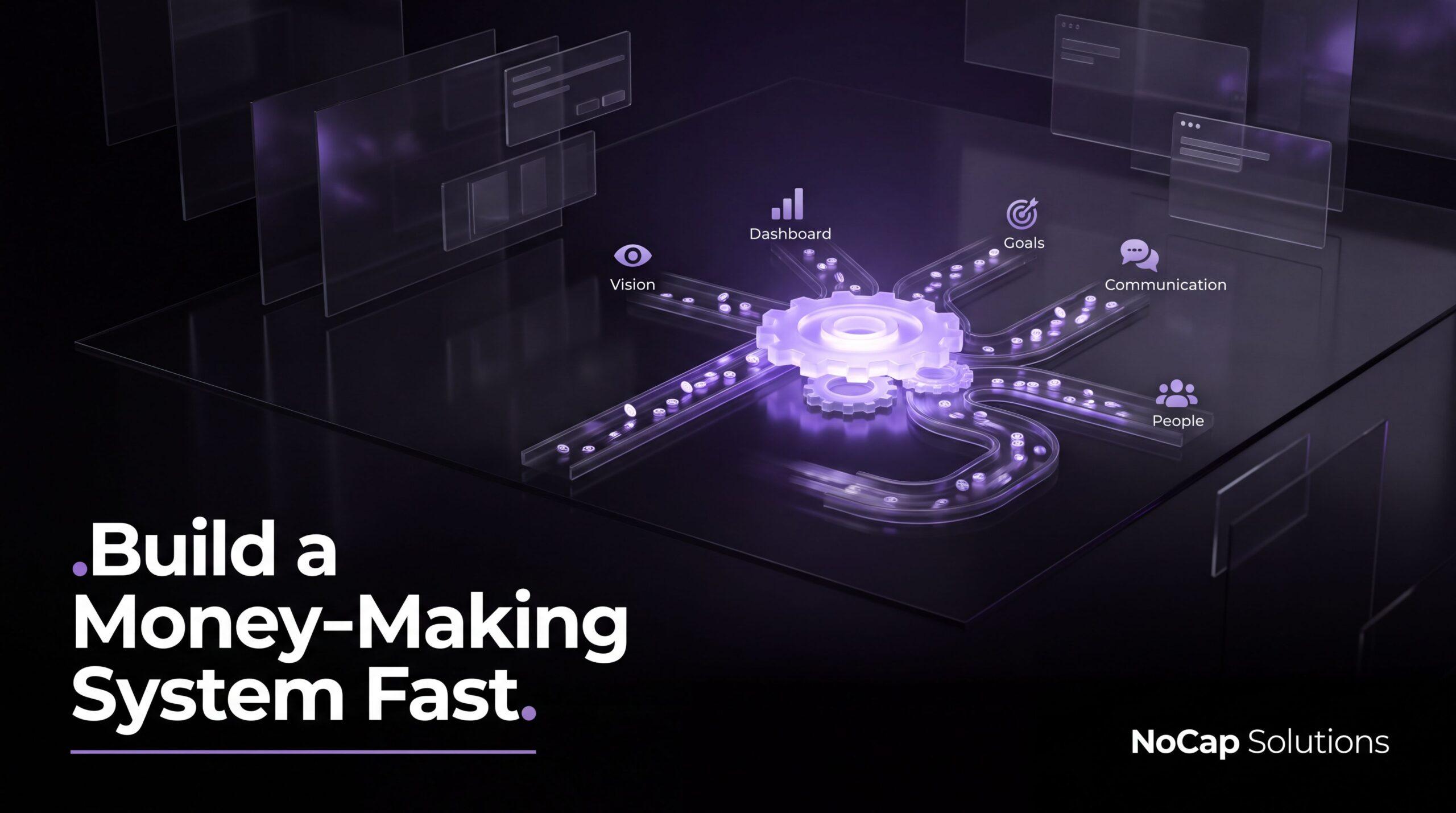
The five parts are Vision, Dashboard, Goals, Communication, and People. Together, they create a scaling operating system that helps leadership answer the questions that actually matter. Where are we going? How do we know if we’re on track? What must happen this quarter? How do we keep the team aligned? Who is responsible for what? Without those answers, the business runs on vibes, and vibes are not a serious operating model. They’re barely a weather report.
Here’s what makes this framework powerful: each part supports the others. Vision tells the team where the business is headed. The Dashboard tells leadership what’s happening right now. Goals turn long-term ambition into a practical destination. Communication keeps the map usable instead of theoretical. People make sure the business doesn’t depend on one exhausted founder trying to do everything manually. When those pieces line up, the company stops feeling like a collection of separate departments and starts feeling like one coherent machine.
That coherence matters because most businesses don’t fail from lack of effort. They fail from lack of alignment. A sales team can be busy while operations is overloaded. Marketing can be generating demand while delivery can’t keep up. Leadership can be proud of “activity” while no one can say whether the company is actually winning. The five-part roadmap is a way to prevent that drift. It forces the business to define what success looks like, measure it, communicate it, and staff it properly.
The beauty of this system is that it’s not abstract. It’s usable. It gives founders a framework that can be built in stages, revised over time, and handed off to others. It also creates a much healthier kind of leadership. Instead of chasing every issue directly, the founder can lead through structure. That’s a huge difference. Direct involvement in every problem eventually becomes a bottleneck. A strong operating system turns leadership into leverage. And leverage is what actually scales.
The five essentials in plain English
- Vision – where the business is heading and why it exists.
- Dashboard – what’s happening now, measured clearly.
- Goals – what must be achieved and by when.
- Communication – how the team stays aligned and informed.
- People – who is responsible for making it all happen.
What matters most is not the list itself. It’s the integration. A company can have a vision without a dashboard and still be blind. It can have goals without communication and still drift. It can have people without clear direction and still waste talent. The roadmap works because it connects the parts.
Design a Strong Vision Plan for the Business
Vision is not a fluffy exercise for later, after the “real work” gets done. It’s the foundation. If the foundation is weak, every other layer gets more expensive to build. That’s why the business needs a real vision plan, not just a hopeful sentence pasted into a slide deck and forgotten by Tuesday. A strong vision plan gives the company orientation. It tells people where the business is going, what kind of company it wants to be, who belongs there, and what success actually means. Without that, even good people can end up rowing in different directions.
A complete vision plan should stretch across a one year, three year, five year, and ten year horizon. That sounds long-term, but it’s actually practical. People need to know whether they’re building for this quarter, this year, or the next decade. New hires especially need this kind of clarity. They’re not just asking what the company is doing today. They’re asking whether joining the business will make their life better in one, three, or five years. Will they grow? Will they earn more? Will they enjoy the team? Will they be proud of the work? A strong vision helps answer those questions before anyone even asks them.
This is also where a company motto becomes useful. A motto is not just branding. It’s identity. It tells the team what kind of people the company attracts and what kind of behaviors it rewards. A motto can act like a filter. It helps the business find the people who actually want to build, not just collect a paycheck and drift through the week. When the motto is clear, the company gets better cultural fit, faster alignment, and a stronger sense of purpose. That’s not a soft benefit. That’s operating efficiency in disguise.
Then there are the north star metrics. The smartest businesses use both a quantitative and a qualitative north star so they don’t accidentally optimize for one thing and wreck another. Revenue matters. So does audience growth, trust, customer satisfaction, brand strength, or whatever else signals long-term health for the company. If the business only optimizes for revenue, it may push too hard, annoy customers, or damage the brand. If it only optimizes for feel-good metrics, it may become popular and unprofitable. The point is balance. In business, a single metric can become a trap if it’s left alone.
This is why a vision plan should include five and ten year targets, not just quarterly ambitions. People need to know the destination, not just the next checkpoint. A clear end goal helps everyone understand what the business is actually trying to become. That matters a lot when you’re hiring, promoting, or deciding what to build next. If the team doesn’t know the larger destination, they’ll fill in the blanks with their own assumptions. That’s how strategy gets muddled. A strong vision removes the guesswork.
And then there’s the personal vision, which is often overlooked. A business can be successful and still be miserable if it doesn’t fit the founder’s preferred life. That’s the quiet failure nobody wants to admit. Someone can build a profitable company and then realize they created a job they would never have accepted from anyone else. Personal vision helps prevent that. It asks: what kind of life should this business support? Does the founder want in-person intensity or remote flexibility? A small team or a large one? A certain pace, location, culture, or kind of work? These choices matter. If they’re ignored, the business can become a prison with good margins.
What belongs in the vision plan
A strong vision plan usually includes:
- A company motto that defines identity
- Values that describe behavior and decision-making
- A clear purpose
- A one, three, five, and ten year direction
- North star metrics that balance growth and health
- A defined end goal
- A personal vision that protects founder fit
- A simple list of what the company sells
That last point matters more than people think. If a team can’t quickly explain what the company sells, the business is probably too fuzzy. Clarity scales. Confusion leaks energy.
Build Strategy Around Avatars, Flywheels, and Product Pillars
Once vision is clear, strategy gets a lot easier to shape. This is where the business stops trying to serve everyone and starts focusing on the customers, systems, and offers that actually create leverage. Three strategic pieces do a lot of heavy lifting here: avatars, flywheels, and product pillars. They sound simple because they are simple. But simple does not mean shallow. In fact, the simplest strategic questions often reveal the deepest problems.
First, the business needs to know its ideal customer avatar. Who is the best buyer? Not the easiest buyer. Not the loudest buyer. Not the buyer who takes the most time and gives the least profit. The best buyer is the one who aligns with the business’s economics, delivery model, and long-term direction. That’s a huge distinction. A company can accidentally build itself around a customer type that creates constant frustration and low margin. Or it can choose an avatar that makes the business healthier and easier to grow. The difference can be dramatic.
A commercial landscaping example makes this obvious. Imagine a company that mostly serves residential clients. Those customers may be plentiful, but the work can be price-sensitive, lower margin, and less sticky. Then imagine that same company looking carefully at its commercial work. It turns out the commercial segment only accounts for 20% of revenue, but it has double the profit margin and far better retention. Now the business has a choice. If it follows the wrong advice, it might cut the commercial side because it looks small. If it follows the economics, it doubles down on the segment that actually builds value. That shift can completely change the company’s trajectory. Sometimes the most profitable part of the business is hiding in plain sight.
That’s why avatars matter so much. The right avatar changes who the company serves, how it sells, how it markets, and what kind of reputation it builds. It also affects morale. A team wants to know they’re serving people who value the work, not a market that treats every interaction like a commodity negotiation. The avatar is not just a marketing decision. It’s an operational and cultural decision.
Then comes the flywheel. A flywheel is the loop that turns one good action into another. For a business with a content-driven model, the flywheel can connect content, mission, deal flow, investors, and growth. The logic is powerful: if the business helps people win, those people trust it more. That trust can lead to leads, referrals, customers, and even investment opportunities. Content can become part of the business model, not just a side activity. When the mission is clear, the flywheel gets stronger because the company isn’t just publishing for attention. It’s publishing to create momentum.
That kind of flywheel works especially well when the business is helping people solve a real problem or move toward a meaningful outcome. The content becomes useful, the brand becomes trusted, and the relationships become more valuable over time. That is very different from random marketing. It’s not about grabbing attention and hoping for the best. It’s about building a system where useful work feeds the rest of the business.
Then there are product pillars. These are the core things the company sells, grouped in a way that makes sense to the team and the market. If the business has multiple offers, they should still live in one clear framework so no one has to guess what the company is actually built to do. Product pillars help the team understand the business model at a glance. They also help with prioritization. If everything is an offer, nothing is an offer. But when the core pillars are clearly defined, the company can sell, market, hire, and plan with confidence.
Why strategy gets easier when the offer is clear
When the avatar is clear, the flywheel is clear, and the product pillars are clear, the business can stop improvising every quarter. That means less confusion in marketing, fewer mismatched hires, more accurate messaging, and better execution across the board. Strategy stops being a brainstorming exercise and starts becoming a map.
And, yes, this is also where a company can quietly make better decisions about what not to do. That might be the most underrated strategic move of all.
Turn Vision Into Execution With Quarterly Planning and Scorecards
A vision that never reaches execution is just an elegant idea. The whole point of the system is to translate long-term direction into weekly behavior. That’s where quarterly planning and scorecards come in. They are the bridge between ambition and reality. They keep the business from drifting into “we’re busy” mode, which is one of the most expensive illusions in leadership. Busy is easy. Focused is harder. Profitable usually comes from focused.
The first move is to break the company into a one year plan and a quarterly plan. The annual plan gives the business a broader frame. The quarterly plan keeps that frame usable. This is where a single annual aspiration can do a lot of work. A one-sentence aspirational plan gives the team a simple direction to hold onto without needing a 40-slide deck to remember what matters. It’s the kind of sentence that can sit above the work and keep everyone oriented when things get noisy.
Then the annual goal needs to become a set of actual projects for each team. Not vague intentions. Projects. Real work with real deadlines. Marketing needs to know what it owns. Sales needs to know what it owns. Operations needs to know what it owns. Finance needs to know what it owns. This turns the plan into a living operating system instead of a motivational poster. It also helps prevent busywork from taking over. Humans are weirdly good at creating small tasks to avoid the hard ones. It’s almost charming, until it consumes the quarter. Quarterly planning forces the team to focus on what actually matters.
The structure around this matters too. Weekly check-ins keep momentum visible. Monthly reviews let leadership assess whether the quarter is on track. Quarterly sprints create urgency and accountability. Annual planning sessions give the business a chance to step back and reset the map. The cadence is important because businesses don’t fail only from bad strategy. They fail from weak follow-through. Regular reviews make follow-through part of the culture.
Now, when the plan is broken down properly, each team member should have weekly tasks tied to projects and deadlines. That sounds basic, but it’s where many teams fall apart. A task without a deadline is just a wish. A project without an owner is just group theater. The execution system should make responsibility obvious. It should be easy to see what is due, who owns it, and whether it’s actually moving.
This is where scorecard-based leadership becomes incredibly useful. A scorecard can show whether the business is red, yellow, or green on the metrics that matter. It can include north stars, company goals, and each person’s project status. It should also show the directly responsible individual for each initiative, often called the DRI. That’s the person who owns the outcome. Not the person who helped. Not the person who had a good idea. The person responsible for moving it forward. When that is clear, leadership can make much better decisions much faster.
A good scorecard doesn’t just say whether something is happening. It shows how far along it is. Is it on track? Behind? Completed? Started? Stuck? That visibility matters because leaders can’t manage what they can’t see. It also keeps the business from sliding into polite fiction, where everybody hopes something is getting done but nobody can quite prove it. The scorecard removes the fog.
How the cadence works in practice
A healthy execution rhythm often looks like this:
- Weekly check-ins – align the team and review active tasks
- Monthly reviews – assess progress against quarterly goals
- Quarterly sprints – reset priorities and push key initiatives forward
- Annual planning – define the next big stretch of growth
The point is not to create meeting overload. The point is to create a rhythm that keeps the business honest. When that rhythm is in place, leadership can see patterns early, correct course faster, and stop waiting until the end of the quarter to discover what went wrong.
Use Scorecards to See the Business Clearly
One of the most underrated leadership tools is a scorecard that tells the truth without drama. It sounds boring. It’s not. It’s actually one of the fastest ways to stop guessing. A well-built scorecard lets leadership see the business the way a driver sees a dashboard. Speed, fuel, warning lights, route status, and who’s doing what all become visible in one place. That changes decision-making immediately because leaders stop relying on memory, optimism, or whoever spoke loudest in the meeting.
A strong scorecard should include the north stars, the company goals, the project completion rate, and the status of each DRI. That means leadership can tell whether a project is in progress, not started, stuck, or done. It also means they can see who is carrying momentum and who needs support. That’s not about micromanagement. It’s about visibility. A business without visibility is forced to manage by surprise, and surprise is a terrible leadership system.
The scorecard also helps answer a question that every founder should ask regularly: am I doing the things that will actually drive the business forward? That question sounds deceptively simple. It cuts through a lot of nonsense. It keeps leaders from mistaking activity for progress. It keeps teams from spending too much time on low-value details. It keeps the business focused on the core outcomes that matter most. If the scorecard says the business is on track, great. If it says something is drifting, that’s useful too. Either way, leadership gets information instead of vibes.
There’s also something psychologically useful about visible status tracking. Humans like to complete things. We’re weirdly drawn to little checkboxes and green markers and the feeling of closure. That can be a strength if it’s aligned to the right work. It can also be a trap if the team starts prioritizing easy wins over important wins. The scorecard helps prevent that because it puts the big priorities front and center. It says, in effect, “yes, the small pebbles exist, but the big rocks pay the bills.”
That idea is crucial. When the core goals and metrics are set correctly, the little pebbles don’t matter nearly as much. The business doesn’t need perfect movement on every tiny task. It needs meaningful movement on the right tasks. That’s the difference between a company that feels busy and a company that becomes more valuable.
A note on DRI ownership
The directly responsible individual matters because ownership clarity prevents work from getting lost in the cracks. Every important initiative should have one person whose name is attached to it. That doesn’t mean they do everything alone. It means they own the outcome. Everyone else can support. But one person has the final responsibility. That’s how execution stops becoming a group fog and starts becoming a disciplined process.
Keep the Business from Running You
This is the heart of the whole framework. Most people get run by their businesses. They don’t run the business. That’s not just a complaint. It’s a warning. A company without systems often ends up consuming the founder’s calendar, attention, and nervous system. Every issue becomes urgent. Every decision gets rerouted through the same person. Every new problem creates more friction. Before long, the business is not a machine for creating value. It’s a machine for creating exhaustion.
The fix is not to care less. It’s to design better. The business needs structures that preserve leadership energy for the things only leadership can do. That’s why the system mindset matters so much. It helps owners stop asking, “How do I get through today?” and start asking, “What structure would make today easier forever?” That question changes everything. It makes the business more mature. It also makes the founder’s role more strategic and less reactive.
This is also where the idea of a system that saves stress, time, energy, and money becomes very real. A good system reduces repeated effort. It cuts friction. It makes decisions faster. It helps people know what to do without waiting for instructions. And when the system is built around actual revenue-driving priorities, it becomes a growth engine rather than a paperwork engine. That’s the goal. A system should not exist to please the founder’s perfectionism. It should exist to improve the business’s performance.
There’s a practical lesson in that. Many owners build systems in reverse. They start with details, formatting, and process maps for tiny tasks. That can feel responsible. But it’s the wrong layer. The better move is to start with the foundation: vision, dashboard, goals, communication, and people. Once those are in place, the smaller systems have a framework to attach to. Then the work of hiring, training, delegating, and scaling becomes much more manageable. The business can breathe.
And if there’s one thing worth remembering, it’s this: the aim is not to build a company that just feels organized. The aim is to build a company that actually works. It should make money, serve customers, support the founder’s life, and give the team a clear path. If it does that, it’s doing the job.
Where NoCap Solutions Fits into the Bigger Picture
For businesses that want to turn this kind of operating discipline into something real, NoCap Solutions can help build the systems layer that makes it all more usable. That matters because the ideas above are powerful, but they still need infrastructure behind them. A company can have a clear vision and still struggle if its dashboards, task flows, and communication systems are fragmented. A better system makes the strategy visible. It turns good thinking into daily execution.
One useful example is NoCap Solutions’ AI Systems Development. It’s a strong fit for businesses that want to map their operations, remove bottlenecks, and build internal systems that actually support growth instead of adding more admin. When the business needs its processes to stop living in people’s heads, that kind of capability becomes especially valuable. It’s not about software for software’s sake. It’s about creating the working structure that lets the company run more cleanly.
If the team is drowning in tasks, another practical angle is NoCap Solutions’ AI Task Management Systems. That kind of system can help businesses create more visibility around ownership, deadlines, and follow-through, which fits neatly with the scorecard and DRI approach described earlier. A business that knows who owns what, and when it’s due, has a much easier time staying aligned. That’s especially useful when leaders want fewer dropped balls and more reliable execution.
For companies that care deeply about visibility into performance, NoCap Solutions’ Live Intelligence and Analytics Dashboards can support the kind of real-time clarity that makes scorecards more actionable. Instead of waiting around for someone to compile numbers, leadership gets a clearer view of what’s moving, what’s stuck, and where attention is needed. That’s the difference between managing from yesterday’s report and managing from today’s reality.
The broader point is simple: the strategy only becomes powerful when the systems behind it are strong enough to carry it. Vision tells the company where to go. Dashboards show what’s happening. Goals keep the direction tight. Communication keeps the map usable. People make it all real. And the right systems layer underneath all of that can turn the whole thing from theory into something the business can actually feel every week.
Why systems support the founder, not just the company
Good systems don’t remove leadership. They protect it. They keep founders from getting buried in repetitive work and force the business to become more explicit about ownership and performance. That means less stress, cleaner decisions, and a company that can grow without demanding constant heroics. In other words, the business becomes something the founder leads – not something that leads the founder around by the nose.
Make the Big Things Count More Than the Small Ones
A lot of businesses get trapped by detail inflation. One small task turns into five more. One meeting turns into a dozen follow-ups. One project turns into a never-ending side quest. Before long, the company is drowning in pebbles while the foundation sits untouched. That’s why the strategic discipline in this framework matters so much. It teaches the business to ignore what doesn’t matter yet so it can protect what matters most.
The core principle is almost annoyingly simple: if the business has the big goals and the big metrics set correctly, the small stuff loses its power to hijack the week. That doesn’t mean small work is never important. It means small work should not outrank the systems that drive growth, trust, and profitability. If the company knows its destination, the little decisions become easier to make. If it doesn’t, every tiny issue becomes a crisis.
That’s why the combination of vision, dashboards, goals, communication, and people is so useful. It creates an environment where the business can make fewer, better decisions. It also creates a company that is easier to lead, easier to hire into, and easier to scale. That’s not a cosmetic upgrade. It’s an operating advantage.
The deeper lesson is that leadership is really about designing for clarity. The clearer the company is, the less it depends on chaos to function. The less it depends on chaos, the easier it is to grow. And the easier it is to grow, the more likely the founder is to build something that actually supports the life they want instead of consuming it.
That’s the promise of a real system. Not perfection. Not decoration. Not a pile of docs sitting in a folder somewhere. A real system gives a business the ability to move with purpose, measure what matters, and keep momentum without burning everybody out.
And that’s the whole game, really. A business should not be a maze. It should be a machine with a map.