
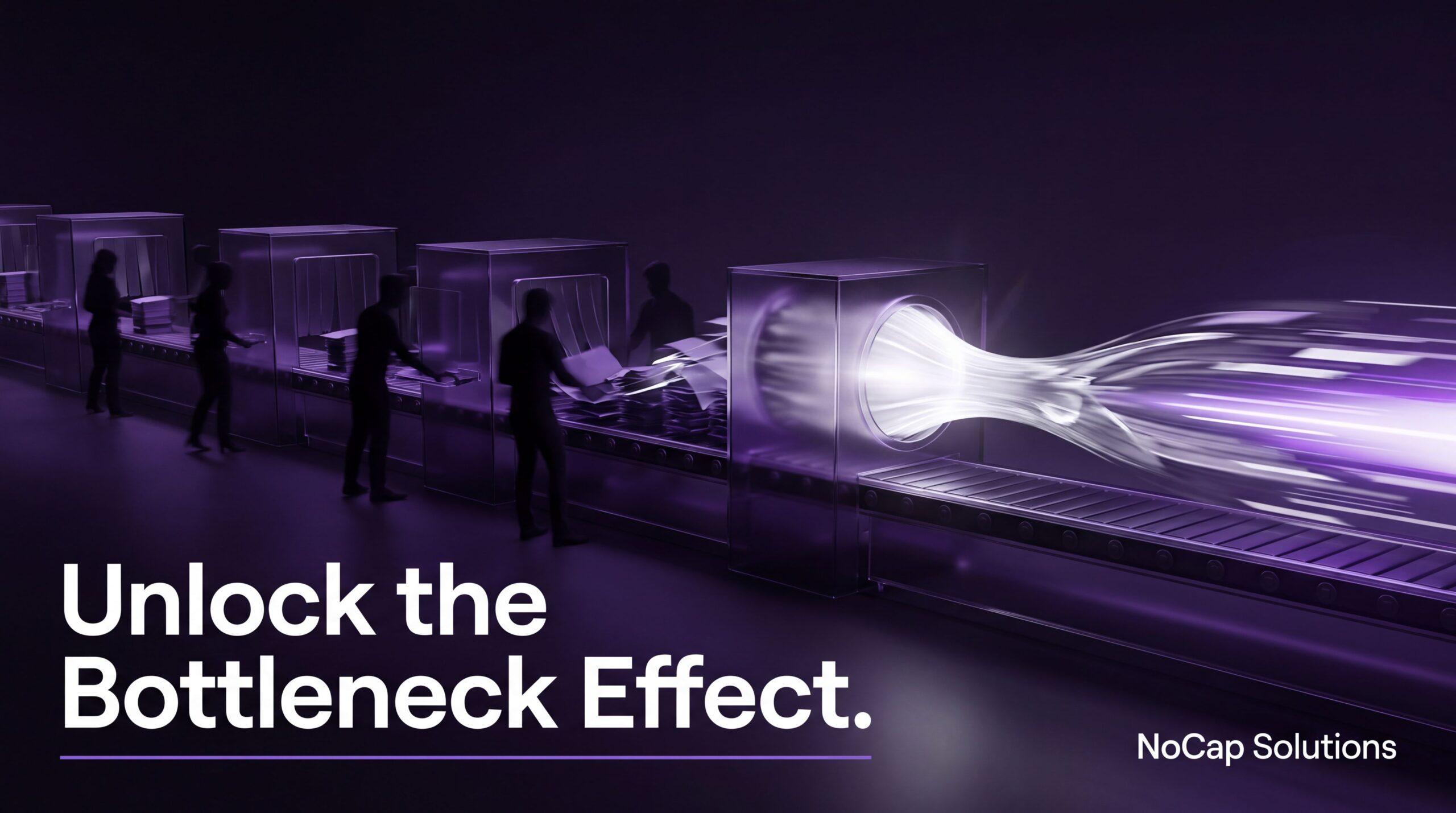
Bottleneck Analysis: Find Constraints and Boost Throughput
Bottleneck Analysis: Find Constraints and Increase Throughput
Learn how bottleneck analysis reveals constraints, defines system capacity, and helps improve throughput with practical examples and theory of constraints steps.
This article will explain bottleneck analysis and why it matters for improving throughput, capacity, and system performance. In any process – whether a production line, a service workflow, or a customer journey – the slowest step quietly sets the pace for everything else.
By understanding how to identify the bottleneck, measure process cycle time, and apply the theory of constraints, you can stop wasting effort on the wrong improvements and focus on what actually raises overall capacity.
1. What Bottleneck Analysis Means and Why It Matters
A business can look busy and still be painfully underpowered. That’s the strange reality bottleneck analysis is designed to expose. It’s the difference between a kitchen where every chef is sprinting and a kitchen where dinner still comes out late because one person is stuck chopping onions with a butter knife. Bottleneck analysis looks at the capacity of a system – whether that system is a service operation, a production line, or a chain of workstations – and identifies the step that constrains everything else. That limiting step is the bottleneck, and it defines the capacity of the entire system.
The important part is that a system is rarely just one thing. It’s usually a chain of activities, each with its own pace, its own workload, and its own capacity. One step might be lightning fast. Another might be slow. Another might be waiting on the second step, which is already behind. The whole system doesn’t run at the speed of the fastest station, even though people often wish it did. It runs at the speed of the slowest effective step. That’s the hard truth, and also the useful one. Once a team understands that, it stops chasing cosmetic improvements in the wrong place and starts asking a much smarter question: where is the real constraint?
This is where bottleneck analysis connects directly to the broader theory of constraints. The theory says every system has at least one limiting factor, and the system can only improve when that factor is addressed. That might sound obvious, but in real companies it gets ignored constantly. Teams often improve the pretty parts of a process – the part customers see, the part leaders like talking about, the part with the clean dashboard – while the real restriction is buried somewhere less glamorous. A non-bottleneck can become more efficient and still have almost no impact on output. That’s not failure. It’s just arithmetic.
This is also why the language matters so much. Capacity isn’t just about effort or speed in isolation. It’s about throughput – how much the whole system can actually produce. If one workstation can process ten units an hour but another can only process four, the system is not a ten-unit system. It’s a four-unit system. That distinction sounds simple, but it changes how leaders think about staffing, scheduling, investment, and service design. A business that sees this clearly stops spreading energy evenly across every task and starts placing energy where the output can actually move.
For example, if a team adds more support agents but the approval step still takes days, the queue just moves somewhere else. If a sales team writes better outreach but the lead qualification process is stuck in manual review, the calendar doesn’t fill any faster. If a factory speeds up packaging while the machine before it still can’t keep up, the stack of work just grows in a different corner. Bottleneck analysis gives the business a map of where reality is pushing back. It’s not glamorous, but it’s honest – and honesty is where operational advantage begins.
In practice, the bottleneck is usually the step with the lowest effective capacity or the longest process time. That’s the part that dictates the pace of the rest. Not because it’s important in some abstract sense, but because the system can’t move beyond it. And once that’s understood, a lot of “we need to work harder” thinking becomes a lot less convincing.
Why non-bottleneck improvements often disappoint
This is one of the most useful mental shifts in operations: improving the wrong thing can create motion without creating progress. A team may reduce cycle time in a fast stage and feel productive, but if the bottleneck remains untouched, total output stays the same. It’s like widening a side road while the highway exit is still blocked. Traffic looks different. The congestion hasn’t gone away.
That’s why bottleneck analysis is so valuable. It helps businesses stop confusing activity with throughput. And in the modern business environment, that difference can determine whether a company scales or merely gets noisier.
2. Core Concepts Behind Capacity, Process Time, and Cycle Time
To use bottleneck analysis well, the core terms need to be clear. Otherwise, teams end up debating words when they should be measuring flow. The first concept is process time. At a single workstation, process time is simply the time required to complete one unit. If one station needs two minutes to process a unit and another needs four, those are their individual process times. Each work area has its own capacity, and each one contributes differently to the whole system.
The next concept is system process time, which is not a simple average. It is defined by the longest process in the entire system. That longest step is the bottleneck. In other words, the process time of the system is controlled by the slowest part, not the fastest one and not the one with the most attention. If a system has several stages, the longest one becomes the limiting factor, because products or customers can’t move faster than that step allows.
Then there’s process cycle time. This is the time it takes for a product or service to move through the process with no waiting. It’s a useful idea because it tells you how long the path is when the system is operating as smoothly as possible, without queue delays. In a perfect-flow world, cycle time captures how long the item spends moving through the sequence of steps. But even in that idealized view, the bottleneck still sets the pace. No matter how elegant the process design looks on paper, the slowest step controls the system’s rhythm.
A good way to think about this is through the concept of system capacity. Capacity is the inverse of system process time. If the process time is 10 minutes, then the system capacity is based on that 10-minute constraint. Put another way, a process that takes 10 minutes per unit can only produce so many units in an hour, and that ceiling is shaped by the bottleneck. If a step takes 10 minutes, then the system’s output is measured against that limit, not against all the faster steps around it.
That’s why customers, products, or work items can appear to be stuck even when several workstations are waiting. Faster stations may sit idle because they’re waiting on the slower one to release flow. This is one of the clearest signs of a bottleneck in real life. The team next to the bottleneck looks underused, and people sometimes assume the answer is to “make them work faster.” But if the bottleneck is still the same, that effort doesn’t change throughput. It just changes who’s waiting.
The hidden truth inside flow
This is where a lot of operations thinking gets flipped upside down. In many businesses, the question is asked backward: “How do we make every step faster?” That sounds efficient, but it’s not strategic. The better question is: “Which step sets the pace?” Once that’s known, the rest of the system can be organized around it. That’s the logic behind bottleneck analysis and, more broadly, the theory of constraints.
It also explains why some systems feel full but don’t actually produce much. Work may be waiting at faster stations because the bottleneck controls the release of flow. So yes, the room may be packed with activity, but the system still moves at one pace. And that pace belongs to the bottleneck.
3. How to Spot the Bottleneck in Real Processes
The easiest way to understand a bottleneck is to picture two people driving from Guelph to Toronto to start a meeting. One arrives in 50 minutes. The other takes an hour. The question is simple: when can the meeting start? Not at 50 minutes. It starts when the slower person arrives, because that person defines the system’s capacity. The faster driver can’t make the meeting happen earlier by shaving more minutes off their own trip. The bottleneck is the one taking the longest.
That example sounds almost too obvious, which is exactly why it’s useful. In operations, people often forget that systems are coordinated around the slowest effective step. They focus on improving what they can see easily, but visibility isn’t the same as importance. A fast step can be busy and still irrelevant to the final output if another step is governing the pace. The business equivalent of “I got there early, so why are we still waiting?” appears all the time. The answer is usually: because someone else is the bottleneck.
A simple assembly line makes this even clearer. Imagine three stations:
- Station A takes 2 minutes
- Station B takes 4 minutes
- Station C takes 3 minutes
At first glance, the line has three productive parts. But the system process time becomes 4 minutes because Station B is the bottleneck. That means the entire line can only move as fast as Station B allows. Station A may be ready in two minutes, but then it sits idle for two more minutes, waiting for the next unit to move. Station C isn’t the problem either, even though it’s slower than Station A. The system’s total output still gets defined by the slowest step: Station B.
This is one of the reasons teams can feel confused when their improvement work doesn’t produce the results they expected. They may improve the wrong station and see no meaningful jump in throughput. That doesn’t mean the improvement was useless. It means the improvement happened outside the constraint. If the bottleneck remains unchanged, the overall pace remains unchanged too.
Looking for bottlenecks in the wild
In real processes, bottlenecks are rarely announced with a sign. They show up as queues, delays, work piling up, people waiting, or one person constantly being “the one to clear things.” They can also appear as a stage that always seems overloaded even when the rest of the team is scrambling around it. The bottleneck might be a machine, a person, a policy, a sign-off step, a shared tool, or even a decision-maker. The form changes. The logic doesn’t.
The key is not to ask where the most noise is. Ask where work is slowing down overall. That distinction matters. A noisy step can be annoying without being the constraint. A quiet step can be quietly controlling the whole business. That’s the sneaky part.
4. Applying Bottleneck Analysis to a Sandwich Line
A sandwich line is a beautiful little laboratory for understanding bottlenecks because it’s familiar, fast-moving, and easy to misread. Consider two identical sandwich lines with two workers and three operations. All completed sandwiches are wrapped. The process looks like this:
- Taking the order takes 30 seconds
- Getting the bread takes 15 seconds
- Filling the bread takes 20 seconds per sandwich
- Toasting takes 40 seconds per sandwich
- Wrapping takes 37.5 seconds per sandwich
At first glance, toasting looks like the slowest step. Forty seconds is longer than 37.5, and both are longer than the others. But the catch is that there are two lines operating simultaneously. That changes the capacity calculation. The toast step is split across two lines, so its effective process time becomes 40 divided by 2, which equals 20 seconds. In other words, the apparent bottleneck is not necessarily the actual bottleneck once parallel capacity is accounted for.
That’s why bottleneck analysis has to look at the whole system, not just the longest number on the page. The combined toast capacity is stronger than it first appears because two lines are doing the work at the same time. So the true limiting step shifts. In this case, wrapping and delivery become the bottleneck because only one person handles that step. Even if toasting looks slow in isolation, the single wrapping step is what ultimately controls output.
Now the math is straightforward. The hourly capacity is calculated as 3600 seconds divided by 37.5 seconds, which equals 96 sandwiches per hour. That’s the rate the system can sustain if demand is sufficient and the rest of the flow is feeding it properly. The process cycle time from order to wrap is 142.5 seconds. That cycle time represents the minimum customer wait time when the line is busy enough to keep moving.
Why parallel work changes the story
This is the part that trips people up: a step can be long, but if it’s duplicated or distributed across parallel paths, its impact on the full system can shrink. That doesn’t mean the work got easier. It means the capacity math changed. When operations run in parallel, the system has to be measured based on how those paths interact, not just on the most obvious single-task duration.
And that’s the bigger lesson. Bottleneck analysis isn’t about hunting the longest task in a vacuum. It’s about understanding how capacity behaves when tasks are shared, split, duplicated, or sequenced. A business with multiple service lanes, multiple people, or multiple technologies can’t just eyeball the slowest activity and call it a day. The system is more clever than that, and more annoying too.
5. What the Dental Office Example Teaches About Parallel Paths
A dental office is another great example because it contains simultaneous work that people often mistakenly add together. In a service system like this, some tasks happen at the same time. A hygienist may be cleaning teeth while the dentist examines the X-ray. That means the system is not one linear path. It’s two overlapping paths that converge into a single patient experience.
Let’s break the cleaning path down:
- Check-in takes 2 minutes
- X-ray takes 2 minutes
- Developing the X-ray takes 4 minutes
- Cleaning takes 24 minutes
- Dentist review takes 8 minutes
- Payment takes 6 minutes
That cleaning path totals 46 minutes. Now compare the X-ray exam path, which totals 27 minutes. Because these tasks happen in parallel, you can’t simply add every step together as though they were sequential. That would overstate the time and distort the capacity calculation. The patient doesn’t sit through the X-ray exam path and the cleaning path one after the other in the same strict way. Some activities overlap.
The important conclusion is that the patient will be there for 46 minutes, because the cleaning path is longer. That means the hygienist is the bottleneck. The hourly capacity is calculated as 60 divided by 24, which equals 2.5 patients per hour, assuming someone else is handling the other activities. Again, the system is limited by the longest path, not by the sum of every path.
This is exactly why parallel paths can be deceptive. They make the operation look busier and more complex than it is. A manager who adds up every visible task might think the visit should take much longer. Another manager might focus on the dentist review time because that’s the prestigious part. But the actual limiting factor is the hygienist cleaning teeth. That is where the throughput is capped.
The operational lesson behind the dentistry example
When companies design customer journeys, they often underestimate parallel work and overestimate linear work. A form gets filled out while a verification happens. A dashboard updates while a manager reviews. A proposal is drafted while pricing is checked. These overlaps matter. The bottleneck isn’t always the most dramatic or most expensive function. It’s the function that controls the longest effective path through the system.
That’s the deeper value of bottleneck analysis. It reveals the real pace of a service, not the imagined one.
6. How to Manage Constraints Using the Theory of Constraints
Once a bottleneck has been identified, the next question is not “How do we improve everything?” It’s “How do we work with the constraint intelligently?” That’s where the theory of constraints comes in. It provides a five-step process for recognizing and managing limitations:
- Identify the constraint
- Improve only in ways that do not ignore the bottleneck
- Develop a plan to overcome the bottleneck
- Focus resources on implementing that plan
- Reduce the effects of the constraint by offloading work and expanding capability
This sequence matters because it keeps the team from doing the classic thing businesses do under pressure: scatter effort everywhere and fix nothing. The theory of constraints says the constraint should be the center of attention. Not every step deserves equal attention at every moment. The system improves fastest when the bottleneck is the object of focus.
A common mistake is trying to optimize a non-bottleneck in the hope that the whole system will somehow catch up. But if the constraint doesn’t move, the system doesn’t move. That’s the discipline of the model. It can feel counterintuitive because people love visible progress. Faster paperwork feels useful. Cleaner forms feel useful. Better handoffs feel useful. Sometimes they are useful, but only if they support the constraint. Otherwise, they’re just nicer scenery around the same traffic jam.
The dental example makes this very clear. If X-ray development gets faster, that may reduce the patient’s wait on one side of the service, but it does not solve the real limitation if teeth cleaning remains the bottleneck. The hygienist still sets the pace. The patient flow still depends on that 24-minute cleaning time. So the business can celebrate a local improvement without confusing it for a system-wide improvement. That’s healthy. That’s honest. That’s how real operational maturity starts.
Offloading and expanding capability
The last two steps in the five-step process are particularly practical. Offloading work means removing unnecessary load from the bottleneck so it can operate closer to its true capacity. Expanding capability means increasing the ability of that constrained step to handle more flow. That might mean automation, better tooling, different sequencing, cross-training, added staffing, or redesigning the work entirely.
But the key is still the same: the change has to touch the constraint. If it doesn’t, it’s noise.
This is where many modern businesses quietly struggle. A team may have strong people, but those people are buried in manual steps that don’t need a human. That means the real bottleneck isn’t effort. It’s design. And once design is the issue, capacity can often be improved far faster than people think.
7. What Happens After a Bottleneck Is Fixed
One of the most interesting things about bottlenecks is that they don’t disappear forever. Once one bottleneck is resolved, another often appears somewhere else in the system. That’s not a failure. That’s how constrained systems behave. You solve the obvious limiter, and the next limiter becomes visible. In that sense, bottleneck management is an ongoing cycle rather than a one-time fix.
This is why companies that treat improvement like a project with a clean ending can get surprised. They improve the constraint, celebrate, and then a new queue appears elsewhere. What changed? The system got better, and now the next constraint is exposed. That’s normal. It’s actually a good sign. It means the business is no longer pretending the old bottleneck is the only thing that matters.
Capacity improvements should therefore be revisited regularly as constraints shift. What was the bottleneck last quarter may not be the bottleneck now. Demand changes. Staffing changes. Tools change. Customer behavior changes. A process that was once constrained by one step may later be limited by another because the first one was improved. This is why continuous improvement can’t be treated as a one-off initiative. It has to become part of how the system is managed.
There’s also a pacing principle here that is easy to overlook: customers should be introduced into the system at the pace set by the bottleneck. If the bottleneck can only handle a certain rate, flooding the process with more work just creates inventory, wait time, and frustration. Lost time at the bottleneck becomes lost time for the entire system. That’s not just a process issue. It’s a customer experience issue.
A business may think it’s being ambitious by pushing more volume into the front of the system. But if the back end can’t absorb it, the result is congestion, not growth. This is why increasing capacity at a non-bottleneck station does not improve total throughput. It can improve local efficiency. It can make a team feel better. It can even make a report look cleaner. But it won’t raise the ceiling of the system. Only the constraint can do that.
Continuous improvement without the fantasy
The real lesson is that bottleneck management is not about chasing a perfect process. It’s about building a process that can keep adapting as the system changes. The constraint moves. The response has to move with it. That’s the practical heart of operational efficiency. Not perfection. Not heroic effort. Not busywork disguised as strategy. Just steady attention to the step that actually determines throughput.
For businesses trying to scale, this mindset is powerful because it prevents wasted effort. Instead of trying to optimize every corner equally, leaders can focus on the point where time, capacity, and revenue are most tightly bound together. That’s where the leverage lives. And leverage, as usual, is the difference between a system that merely works and a system that actually grows.
8. Using Bottleneck Thinking to Build Smarter Operations
The reason bottleneck analysis matters so much in the modern business environment is that most companies are not short on effort. They’re short on flow. Teams work hard, tools multiply, dashboards fill up, and yet the system still underperforms because one stage quietly governs the rest. Bottleneck thinking changes the conversation from “How do we make everyone busier?” to “Where does work actually get stuck?” That’s a much more useful question.
This is also where a business can start seeing operations as a system rather than a pile of tasks. Once the system view becomes normal, it gets easier to spot waste, delay, and misalignment. A step that looks productive in isolation may be a distraction if it’s not the constraint. A small change in the bottleneck can create a bigger result than a large change somewhere else. That’s the weird beauty of systems thinking – leverage hides in plain sight.
For leadership teams, this often means making a distinction between visible labor and limiting labor. Visible labor is easy to notice. Limiting labor is what holds the rest of the chain back. They are not always the same thing. The bottleneck may not be the most expensive employee, the most stressful department, or the step with the most complaints. It may simply be the step that takes the longest or has the lowest effective capacity. Once found, it becomes the place where meaningful improvement can happen.
That’s also why the theory of constraints pairs so well with operational design. It stops businesses from treating every problem as equally urgent. Not every problem is equally important. Some issues are annoying but harmless. Others are actually capping growth. Knowing which is which is half the battle.
A final practical way to think about it
If the system were a river, the bottleneck would be the narrowest section. Widening a broad part of the river might look impressive, but the water still can’t move faster than the narrow part allows. That’s bottleneck analysis in one picture. It’s not about fixing everything. It’s about widening the point that matters.
And once a business sees that clearly, it gets a better grip on staffing, sequencing, customer flow, and capacity planning. That’s how operations become less reactive and more intelligent. It’s also how a company starts using its resources with a little more precision and a lot less guesswork.
9. Where Smarter Systems Fit Into Bottleneck Reduction
Bottleneck analysis becomes especially powerful when a business combines it with better systems. If a step is constrained because a human keeps having to copy data, route tasks, chase missing information, or rebuild the same work over and over, then the issue may not be “lack of effort.” It may be that the process is forcing unnecessary manual handling into the bottleneck.
That’s the kind of problem where intelligent systems can make a real difference. For example, NoCap Solutions builds AI Task Management Systems that create, assign, prioritise, chase and close work without a team acting as a human router. In a bottleneck-heavy operation, that matters because the constraint often gets clogged by coordination work rather than the core task itself. If tasks can generate themselves from emails, calls, forms, messages, documents or contract dates, the team stops losing time to the overhead that slows the whole system down. The business still has a bottleneck – every system does – but the bottleneck becomes cleaner, lighter, and easier to improve.
A similar logic applies to NoCap Solutions’ AI Automation Solutions. When processes can listen, decide and act on their own, they stop putting humans in the middle of work that doesn’t need them there. That’s useful anywhere the constraint is being dragged down by repetitive admin, delayed handoffs, or preventable waiting. The point isn’t to automate for the sake of drama. The point is to remove friction from the step that matters most.
In support-heavy operations, NoCap Solutions also offers Customer Support AI Systems, which resolve routine questions around the clock, escalate only what needs a person, and flag recurring issues at the source. That can matter in bottleneck terms because support queues are often a hidden constraint on growth. If the team is constantly answering the same question for the four hundredth time, the bottleneck isn’t customer volume alone. It’s the system’s inability to absorb and route that volume intelligently.
These examples aren’t here to distract from the core lesson. They point back to it. Better systems don’t replace bottleneck analysis. They make it more effective. They reduce the amount of noise surrounding the constraint so the business can see the actual limiting step and improve it with more precision.
Why this matters for growth
Growth usually doesn’t fail because a business lacks ambition. It fails because one part of the system can’t keep up. The best operations teams know that scaling is less about pushing harder and more about removing the thing that keeps the system from breathing. That’s why bottleneck analysis, theory of constraints, and intelligent process design belong in the same conversation. They all ask the same question in different ways: what is really stopping the system from doing more?
And once that question is answered honestly, the path forward gets a lot clearer.