
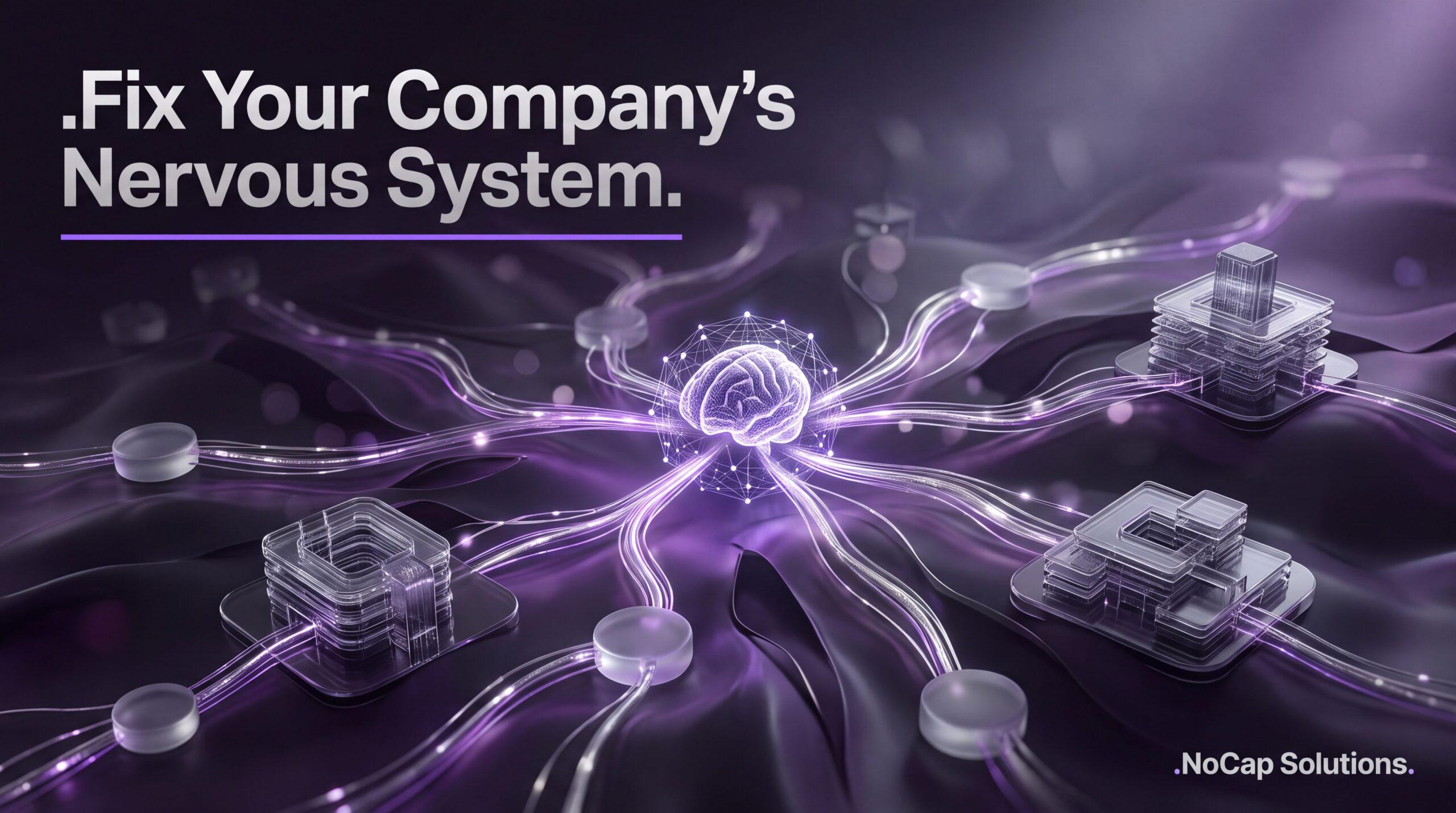
Fix Your Company’s Nervous System: Scale Without Chaos
Reset Your Company’s Nervous System: Achieve Scalable Growth
Discover how aligning your company’s operations like a nervous system can drive clarity, empower teams, and support scalable growth.
This article will explore the concept of a company’s nervous system and how maintaining effective processes and operations can prevent chaos during growth. By comparing human physiology to business dynamics, the post highlights why understanding your company’s nervous system is key to long-term success. The discussion covers organizational symptoms, operational challenges, and actionable strategies to ensure your people, systems, and vision work together seamlessly.
1. Understanding the Company’s Nervous System Analogy
Imagine a company as a living organism with a complex nervous system. Just as the human body relies on a central brain, intricate neural pathways, and a network of signals to function, a business operates with a foundational vision, interconnected processes, and crucial relationships that determine its overall health. In this analogy, the CEO often embodies the brain – the central core that generates vision, sets direction, and attempts to coordinate countless moving parts. However, when the signals between departments, employees, and systems become misaligned, the entire organism shows symptoms not unlike a human suffering from confusion, chronic headaches, or fatigue.
The company’s nervous system comprises several essential components. It begins at the very core: the vision or what might be considered the “brain’s command center.” This is where strategic goals are conceived and where software, processes, and people are expected to manifest those ideas. Yet, for that vision to be effectively executed, it must cascade into clear, actionable signals transmitted throughout the organization. Whether it’s setting clear priorities, ensuring every stakeholder understands their role, or maintaining robust communication channels, the health of an organization depends on these signals being sharp and consistent.
In many organizations – especially those in the $4 million to $25 million revenue range – the symptoms of a failing nervous system become apparent:
- Confusion among employees: When teams find that their daily tasks do not align with the overarching goals, they lose sight of how their contributions drive success.
- Misaligned priorities: Much like a body that fails to prioritize its need for oxygen or nourishment, companies sometimes focus on quick fixes that address surface-level symptoms rather than the underlying causes.
- Operational breakdowns: As roles blur and communication stagnates, decision-making slows down. The “headache” of a malfunctioning nervous system becomes a daily reality.
These issues highlight a fundamental challenge: ensuring the company’s core vision is not just a lofty idea, but a clear, shared directive that permeates every level of the organization. The process of guiding this vision into every corner of a company is not unlike aligning all neural signals so that every muscle and organ works in concert. Businesses that get this right find that their operations become smoother, and the often intangible “vibe” of an organization transforms into measurable, effective progress.
When CEOs speak about operational challenges, the symptoms they describe – hiring missteps, miscommunication, and technology updates – are usually not the root cause but are the surface ripples of deeper issues. Much like a patient reporting a headache without understanding its cause, company leaders must resist the temptation to treat these signals as standalone problems. Instead, leaders should look inward – at their company’s vision, processes, and the relationships that sustain them – to diagnose and treat the real source of dysfunction.
Consider the analogy further: a human nervous system requires constant maintenance – like regular exercise, balanced nutrition, and stress management – to function at its best. Similarly, a business must invest in continuous communication, regular training, and consistent process evaluations. Ignoring these needs leads to rapid degradation in performance. When a company’s nerve-center falters, the entire operation can slow to a crawl, echoing the way a human body might react to neglect or imbalance.
The beauty of this analogy is its clarity. It offers a way to understand that what looks like isolated issues are often interconnected symptoms of a deeper misalignment. Just as medical professionals seek to understand the body’s internal signals rather than merely prescribing painkillers, business consultants must delve into the “nervous system” of the organization – its vision, communication channels, and operational processes. In doing so, they unearth the real problems and create holistic strategies to restore balance and ensure the company’s longevity.
At its core, the nervous system analogy serves as a diagnostic tool. It gives leadership a clear and relatable framework to pinpoint where communication is breaking down, where roles are unclear, and where accountability is lacking. In effect, it transforms vague concerns into a more tangible map of review and intervention. For example, when a CEO mentions symptoms such as “I think we just hired the wrong people” or “I need to update our technology,” these signs are akin to a fever in a human – indicators that something in the system is out of balance.
By understanding the company in this way, leaders can begin to realign their operations. There is an inherent need to merge a compelling vision with operational efficiency. When every department, team, or even individual understands their role in this larger system, the nervous system not only functions – it thrives. Employees become more engaged because they see themselves as vital contributors to the company’s overall health, rather than as cogs in an inefficient machine.
In time, organizations that commit to nurturing this “nervous system” achieve a state where operations and vision move in lockstep. Their strategies are not limited to one-off fixes or temporary measures; instead, they invest in long-term alignment that continuously adapts to the company’s growth. The resulting synergy is one where operational efficiency, talent management, and innovative technology work together seamlessly to propel the business forward.
2. Operational Challenges: From Decision Making to Talent Management
Moving deeper into the operational landscape, many companies wrestle with the challenges that arise from overloaded decision-making processes and talent management woes. Picture a scenario where the CEO is the sole decision-maker, handling every query, shift, or change in strategy single-handedly. While this centralization might seem efficient at first glance, it inevitably creates bottlenecks, leading to a sluggish flow of information and delayed execution – similar to an overworked brain trying to process too many signals at once.
The story is familiar: a visionary CEO, brilliant with big ideas, finds themselves entangled in every minute operational decision. This creates a paradox where the essential leadership quality – the ability to see the big picture – is drowned out by the minutiae of daily operations. The CEO’s role, instead of being the strategic head of the company, becomes a bottleneck where every decision must pass, often causing delays that ripple throughout the organization. In the same way that a human brain cannot process every sensory input simultaneously, a company cannot function smoothly if all decisions converge at a single point of control.
Several operational challenges surface as a result. One of the most evident is the reliance on symptoms rather than causes. When an executive team hears complaints about issues like the wrong hiring decisions or communication breakdowns, it might be tempting to address these problems in isolation. However, these symptoms are merely the visible manifestations of deeper problems within the operational nervous system. Like treating a headache without diagnosing its origin, a focus solely on symptoms misses the opportunity to cure the underlying ailment.
Talent management is another critical aspect. Many organizations dive into missteps in hiring without addressing the education and ongoing training required for sustained growth. The issue is not just about bringing the right talent on board; it’s about continuously nurturing and educating that talent so they can adapt as the business scales. One-time training sessions are insufficient in an environment where operational priorities and technologies evolve rapidly. Just as an athlete requires ongoing coaching rather than a one-time lesson, employees need continuous professional development to stay aligned with the company’s shifting needs.
Within operational challenges, the human element becomes paramount. Relationships form the core of any effective nervous system – both in living beings and in companies. Employees and teams need clarity about their roles, as well as a deep sense of accountability. Without this, even the most carefully crafted operational protocol fails to deliver its promised results. When a team member is unsure of their priorities or doubts where their contributions fit within the larger vision, the organizational nervous system falters. This ambiguity can lead to repeated misunderstandings and inefficiencies that echo through every level of the business.
Let us consider a few specific challenges in more detail:
Decision-Making Bottlenecks
In many organizations, decisions funnel through a single point, typically the CEO. This centralization often creates a scenario where the right decisions face significant delays simply because they have to wait for one individual’s input. The strategy sounds logical – after all, a unified vision is best managed by one voice – but operational reality tells a different story. For example, when the CEO must evaluate every minor decision, it not only overloads them but also leaves little room for delegation and distributed leadership. This slow decision-making process exacerbates operational issues during periods of rapid growth, where agility and speed are essential.
The operational challenge here is twofold. First, relying on one person for decisions means that the wealth of knowledge, ideas, and insights from the broader team is untapped. Second, it risks creating a culture of dependency, where employees become passive, waiting for instructions rather than taking initiative. A well-functioning organization divvies up responsibilities and empowers employees to act with clarity and accountability. This distributed decision-making process can be likened to a finely tuned biochemical system, where each neuron responds promptly to the body’s needs, rather than waiting for a top-down command.
Talent Management and the Role of Continuous Education
Another prevalent challenge is the tension between hiring talent and empowering existing teams through ongoing education. Often, the conversation centers around recruiting the “right” people and lamenting hiring mistakes. While good hiring practices are vital, the root issue frequently lies in the failure to properly integrate and educate employees on the evolving expectations and processes of the company. Imagine a sports team where star players are hired continuously, but the coach never adjusts the training routines or strategies; the potential of the team remains unrealized. That is precisely the pitfall of one-off training sessions that yield temporary competence but not sustained expertise.
Ongoing education serves as the continuous flow of nutrients to the company’s nervous system. It keeps each employee updated on changing priorities, new systems, and innovative processes. In essence, it transforms knowledge into a dynamic asset rather than a static resource. The result is an empowered workforce where every team member understands their unique contribution and is adequately equipped to address challenges as they emerge. This strategic approach not only addresses the symptoms – such as miscommunication or missed deadlines – but also eradicates the underlying dysfunction in operational processes.
Emphasizing Relationships and Accountability
Central to operational success is the cultivation of robust relationships and clear accountability across all levels of the organization. When employees are unsure of where they fit in the organizational structure or lack clarity about who is responsible for what decisions, operational efficiencies crumble. It is not merely about assigning roles; it is about instilling a sense of ownership and encouraging collaboration across departments. The nervous system of an organization thrives on the constant and clear relay of signals among its many parts.
This emphasis on relationships is analogous to the connections between neurons in the human body. Just as a healthy neural network depends on efficient transmission of electrical signals, a company relies on robust, transparent communication channels and a well-defined accountability structure. Both elements ensure that decisions and feedback travel swiftly and accurately, maintaining the rhythm essential for growth and responsiveness.
Businesses that invest in creating a collaborative environment reaped substantial benefits. When processes are clear, and every employee understands their part in the larger framework, the productivity of the entire organization improves. Moreover, empowered employees are more likely to innovate, propose improvements, and take calculated risks – qualities that are indispensable in today’s fast-paced business environment.
3. The Pathways to Impact Operating System and AI Integration
To address the multifaceted challenges described above, some companies look to sophisticated frameworks that integrate operational excellence with modern technological advances. One such innovation is the Pathways to Impact Operating System – a comprehensive approach that restructures the company’s nervous system by focusing on five key components. This system not only diagnoses the symptomatic issues but also builds a resilient foundation that can adapt to growth and integrate emerging technologies like Artificial Intelligence (AI).
Breaking Down the Five Key Components
The Pathways to Impact Operating System is built around five interlocking components that serve as the building blocks of a robust operational framework. Each component targets specific symptoms that hamper growth and efficiency:
-
Decision Flow:
This component scrutinizes the channels through which decisions travel in the organization. It asks critical questions such as, Who is making the decisions? How is information transmitted? Where are the breakdowns occurring? When decision flow is impeded, the result is a bottleneck that stifles innovation and operational agility. An effective decision flow nurtures a decentralized decision-making model where multiple managers are empowered to act within clearly defined boundaries. This not only alleviates the CEO’s burden but also ensures that insights from various levels contribute to smarter, faster decisions. -
Structural Clarity:
As companies grow, they naturally evolve from flat structures to more layered organizations. Structural clarity means that every employee understands their role, their reporting line, and how their work integrates into the broader corporate mission. Lacking this clarity is akin to having a foggy neural network – signals become misdirected, and the organization stumbles over miscommunications. By establishing clearly defined layers, companies can prevent overlapping responsibilities and streamline the chain of command. -
Information Flow:
Operational success hinges on the free flow of information. Effective information flow means that every team member, from the executive table to the frontline employees, knows what is expected over the next 30 days, quarter, or year. When answers vary across leadership teams, it signals a breakdown in communication that can lead to misaligned efforts and missed opportunities. A robust information flow mechanism ensures consistency and transparency, which in turn cultivates a shared sense of purpose across the organization. -
Leadership Regulation:
Just as a healthy nervous system needs regulatory mechanisms to prevent over-stimulation, the leadership within a company requires systems to maintain harmony and coherence. Leadership regulation involves setting up protocols and feedback loops that enable leaders to monitor performance, recalibrate expectations, and ensure that the company culture remains unified even in times of rapid change. When leadership becomes erratic or inconsistent, it affects the entire company’s morale and performance. -
Identity Capacity:
This final component emphasizes a company’s ability to adapt to changing market conditions without losing sight of its core identity. As businesses evolve, the skills required of employees shift. Identity capacity ensures that the organization remains agile, capable of integrating new competencies without a dramatic overhaul of personnel. When companies invest in identifying these shifts early, they prevent capacity problems before they stifle progress.
Integrating AI to Enhance the Nervous System
In today’s rapidly evolving business landscape, AI has emerged as a powerful ally in addressing complex operational challenges. However, the integration of AI into a company’s systems must be done thoughtfully. AI, while powerful, is not a magic cure-all – it cannot replace the intrinsic understanding and strategic vision that a healthy nervous system provides. In this context, AI should be seen as a tool that complements and amplifies an already sound operational foundation.
For instance, AI technologies are excellent at processing vast amounts of data at unparalleled speeds. They can spot subtle patterns or trends that a human might overlook, similar to how modern diagnostic tools in medicine detect issues before symptoms become severe. In many companies, AI is increasingly used to monitor real-time metrics, flag inconsistencies, and even propose tactical adjustments. However, the effectiveness of these AI systems depends entirely on how well the underlying processes are defined.
The key to harnessing AI lies in ensuring that the company has first established a clear organizational structure – a coherent nervous system. If roles, responsibilities, and decision flows are poorly defined, AI might simply amplify the existing chaos rather than provide clarity or efficiency. For example, AI-driven dashboards or decision-making tools will struggle if the underlying data is ambiguous or if the personnel interpreting the data do not understand the broader strategic context. It is much like having a sophisticated diagnostic machine in a poorly maintained human body – the results may be impressive, but they do not automatically translate into improved health unless the root issues are addressed.
In practical terms, the integration of AI into a robust operating system means aligning digital tools with the company’s vision and long-term strategy. It involves mapping out which processes can benefit from automation, how best to utilize real-time intelligence, and ensuring that every technological addition supports rather than disrupts the established flow. The roles that AI plays can vary broadly – from automating routine data collection to offering predictive insights that help pre-empt operational breakdowns.
Establishing an Operational Foundation Before AI
Before any company can leverage the benefits of AI, it must establish its operational fundamentals. This means looking inward and asking critical questions like, Who are we as an organization? Who do we serve? What problems are we uniquely poised to solve? Once these core questions are answered and the company’s nervous system is fully functional, AI can seamlessly integrate into the existing framework as an accelerant for efficiency.
In this regard, one notable solution offered by NoCap Solutions is the AI Strategy and Systems Architecture. Not only does this product help companies map out detailed, prioritized roadmaps for building or enhancing their operational systems, but it also emphasizes that strategy always precedes technology. By ensuring that every process, every role, and every communication channel is optimized first, companies can then deploy AI tools confidently, knowing that these technologies will enhance a system that is already in balance.
Maintaining this foundational clarity is critical. It ensures that AI contributes to a coherent and agile operational framework rather than introducing another layer of complexity. In other words, the AI becomes an extension of the company’s nervous system, amplifying efficient decision flows, facilitating structural clarity, and enhancing the overall speed of information circulation.
A Reflexive Future: Balancing Human Insight and AI Precision
The narrative of AI in operations is one of balance – between human insight and technological precision. The path forward is not to replace the human element but to free it from the mundane aspects of everyday operations. With a solid nervous system in place, companies can use AI to handle repetitive tasks, data analysis, and even provide real-time alerts that preempt potential issues. This, in turn, allows the executive team and line managers to focus on strategic, high-impact decisions rather than getting bogged down in micromanagement.
A company that understands its nervous system and reinforces it with the right operational processes is akin to a well-trained athlete who uses technology not as a crutch, but as a tool to hone performance. High-performing organizations observe that while AI may catch up quickly in terms of processing speed or data retrieval, it remains subordinate to the insights derived from well-structured human processes. AI may analyze a drop in performance metrics, but only the clear-headed evaluation of human leadership can translate such data into actionable business strategies.
Furthermore, the integration of AI must be viewed as an ongoing conversation between technology and organizational structure. It is not a one-time plug-and-play solution but a progressive enhancement – one that evolves alongside the company’s changing needs. In this dynamic interplay, the role of leadership becomes analogous to that of a conductor, ensuring that every tool, every process, and every team member plays in harmony with the overarching vision.
The Ripple Effect: From Operational Health to Sustainable Growth
Ultimately, the careful diagnosis and repair of an organization’s nervous system is not solely an exercise in operational optimization – it is a strategic initiative that creates the foundation for sustainable, long-term growth. When companies invest in aligning vision, refining processes, and enhancing communication, the result is a system that responds nimbly to market changes, competitive pressures, and even unexpected challenges. An efficient nervous system transforms the organization from a reactive entity into one that anticipates and adapts to changes with confidence.
Consider a scenario where a company’s operations are in continuous disequilibrium. The CEO, overburdened by daily decisions, struggles to impart the correct priority framework, while employees become disengaged, unsure of expectations. The resulting operational inertia not only stifles growth but also erodes the company’s competitive edge. In contrast, when the nervous system is healthy – when every decision flows seamlessly, every role is defined, and the information circulates unhindered – the organization develops a rhythm that can quickly recalibrate and respond to shifts in the market.
This ripple effect from operational health extends well beyond internal efficiencies. With a streamlined nervous system, the business is better positioned to seize growth opportunities as they arise. Improved decision flow speeds up innovation cycles, enhanced structural clarity reduces wasted effort, and a robust information flow cultivates a culture of continuous learning and adaptation. When these components work in tandem, they elevate the overall performance of the company, making it not just competitive in its current market but also future-proofed against the inevitable challenges of change.
Concluding Insights: The Interplay of Vision, Process, and Technology
In sum, viewing a company through the lens of a nervous system offers a revealing perspective on how operational health and efficiency are interconnected. The central core – or vision – must be clearly defined and communicated. The pathways along which decisions, information, and accountability travel need constant nurturing and clarity. And finally, as the digital age ushers in powerful AI tools, these technologies can only thrive if integrated into a system that is already aligned and robust.
The journey from operational chaos to streamlined efficiency requires a methodical approach. It begins by diagnosing the symptoms – the confusion, misaligned priorities, and processing bottlenecks – and then proceeds to address the underlying causes. By investing in continuous talent education, decentralizing decision-making, and fostering strong interdepartmental relationships, companies can build an operational nervous system that is both resilient and flexible.
Coupled with the thoughtful integration of AI, organizations can elevate their performance to a new level. The potential of AI lies not in replacing the human touch, but in augmenting it – making every signal clearer, every decision smarter, and every process more responsive. As companies evolve and their operational needs become more complex, maintaining a balanced, well-tuned nervous system will be the defining factor of long-term success.
In a world where technology continues to advance, the fundamental truth remains: success is built on clarity, alignment, and adaptability. With platforms like NoCap Solutions’ AI Strategy and Systems Architecture, businesses can map out, build, and sustain an operational framework that not only handles today’s challenges but is agile enough to adapt to tomorrow’s opportunities. By embracing the nervous system analogy, executives and operational leaders are empowered to see beyond the immediate symptoms and set in motion a transformative strategy that drives efficient growth and fosters a culture of innovation across every layer of the organization.
To conclude, the integration of a healthy operational nervous system with the advanced capabilities of AI creates a synergy that propels companies forward. It redefines the way decisions are made, talent is nurtured, and operational metrics are monitored – transforming the organization into a dynamic entity capable of thriving in a competitive marketplace. The journey is challenging, yet the rewards are substantial: sustained efficiency, empowered leadership, and a future-ready organization that understands the true value of every internal connection.
In today’s fast-paced business environment, where every moment counts and the stakes are high, investing in the health of the organizational nervous system is not merely a strategy – it is a necessity. Companies that undertake this journey learn that real innovation starts at the core, and when every component functions in harmony, the outcomes are truly transformative.
The interplay of vision, process, and technology is the hallmark of sustainable growth. With deliberate efforts to nurture internal signals, clarify roles, and strategically integrate AI, businesses are not only prepared to weather the storms of operational hiccups but are also positioned to harness new opportunities as they emerge. In this way, the operational nervous system becomes both the diagnostic tool and the engine for future success, ensuring that companies remain agile, empowered, and ready to face the challenges of an ever-changing digital era.